


⚙️20°–200° Adjustable Magnetic Welding Angle Holder
Stop Holding the Steel With the Hand You Need for Welding.
Set the angle, let the magnetic faces help hold compatible steel in position, then keep your hands where they matter for alignment, tacking and fabrication.
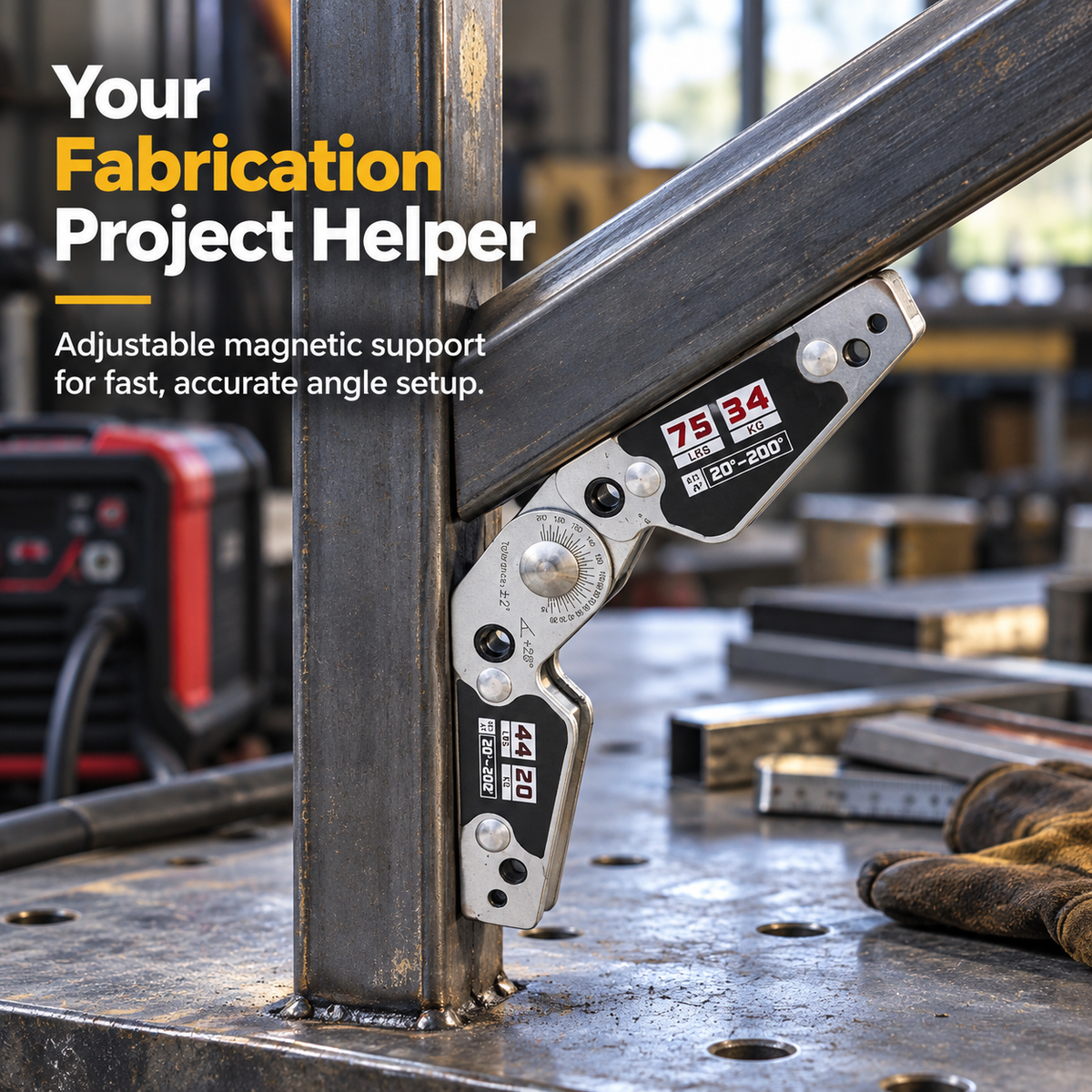

The Hard Part Often Happens Before the Arc Even Starts.
Trying to hold one tube, keep another tube at the right angle and still control the welding torch can turn a simple fit-up into an extra pair-of-hands problem.
A slight shift can change the joint position before the first tack.
One hand holding steel is one less hand available for positioning and welding work.
Not every brace, frame or fabricated part conveniently lands at 45° or 90°.

Set the Angle the Project Needs.
Product imagery shows an adjustable scale from 20° to 200°, letting the holder support a much wider range of fabrication layouts than a fixed-angle welding magnet.
Useful when the joint needs a shallow approach.
Common frame and perpendicular positioning work.
Allows the arms to move well beyond a conventional right angle.
The product title and angle-scale imagery show 20°–200°, while one seller bullet states 25°–200°. Verify the actual minimum stop on the item received if that lower range is critical to your work.

Spend Less Time Improvising a Third Hand.
Place the magnetic faces against compatible steel, adjust the joint angle, tack the assembly and reposition the holder for the next fabrication step.
Bring the compatible ferromagnetic workpieces into the desired layout.
Set the arm position while referencing the visible angle scale.
Confirm the joint before continuing with the welding sequence.

Keep the Joint in Position While You Get the First Tack Down.
The magnetic holder is most useful during layout and fit-up, helping maintain compatible steel pieces while you establish the joint before the full weld.
Seller copy states both inside and outside sections provide magnetic holding surfaces.
Magnetic assistance does not replace measuring, squaring or verifying the finished layout.
Reduce the need to manually support both steel pieces during the initial positioning stage.
Frames, Braces, Tubing and Everyday Shop Builds.
The adjustable format is especially useful when your project includes several joint angles rather than repeating one fixed geometry.

Match the Holder to the Scale of the Work.
Seller imagery presents both small and large versions of the adjustable magnetic holder. Confirm the exact size and holding specification of the option shown in your storefront before ordering.
Better suited to more compact pieces and tighter fabrication areas.
Provides a larger physical footprint for bigger workpieces.
Current seller text and product imagery show conflicting magnetic-force figures, so no single force rating is promised here.
Four Reasons It Earns Space on a Fabrication Table.
The adjustable joint lets one holder cover a broader range of fabrication layouts.
Helps temporarily support compatible ferromagnetic steel during fit-up and tack preparation.
Reduce the need to physically hold both workpieces while trying to position the joint.
Move from one joint angle to another instead of collecting separate magnets for every geometry.
Specifications
Exact magnetic force varies with product size and can also be affected by workpiece thickness, contact area, surface condition and geometry. Current seller imagery and copy do not provide one internally consistent force rating, so no single holding-force guarantee is made here.
Check the Joint Before You Commit to the Weld.
Treat the tool as a fabrication positioning aid and confirm the workpiece is stable, aligned and appropriately supported before continuing.